
Buffers 101
Riparian Forest Buffers
What is a riparian forest buffer?
Forest buffers, also called riparian or streamside buffers, are the trees, shrubs and other plants that grow next to streams and rivers.
Buffers are critical to the health of the land and to the Chesapeake Bay – they prevent pollution from entering waterways, stabilize stream banks, provide food and habitat to wildlife and keep streams cool during hot weather. For a more detailed definition, visit this USDA page.

Buffer FAQs
How much do buffers cost?
Can I plant fruit trees?
What about weeds?
Find the answer to these and many other questions in our Buffer FAQs (PDF).
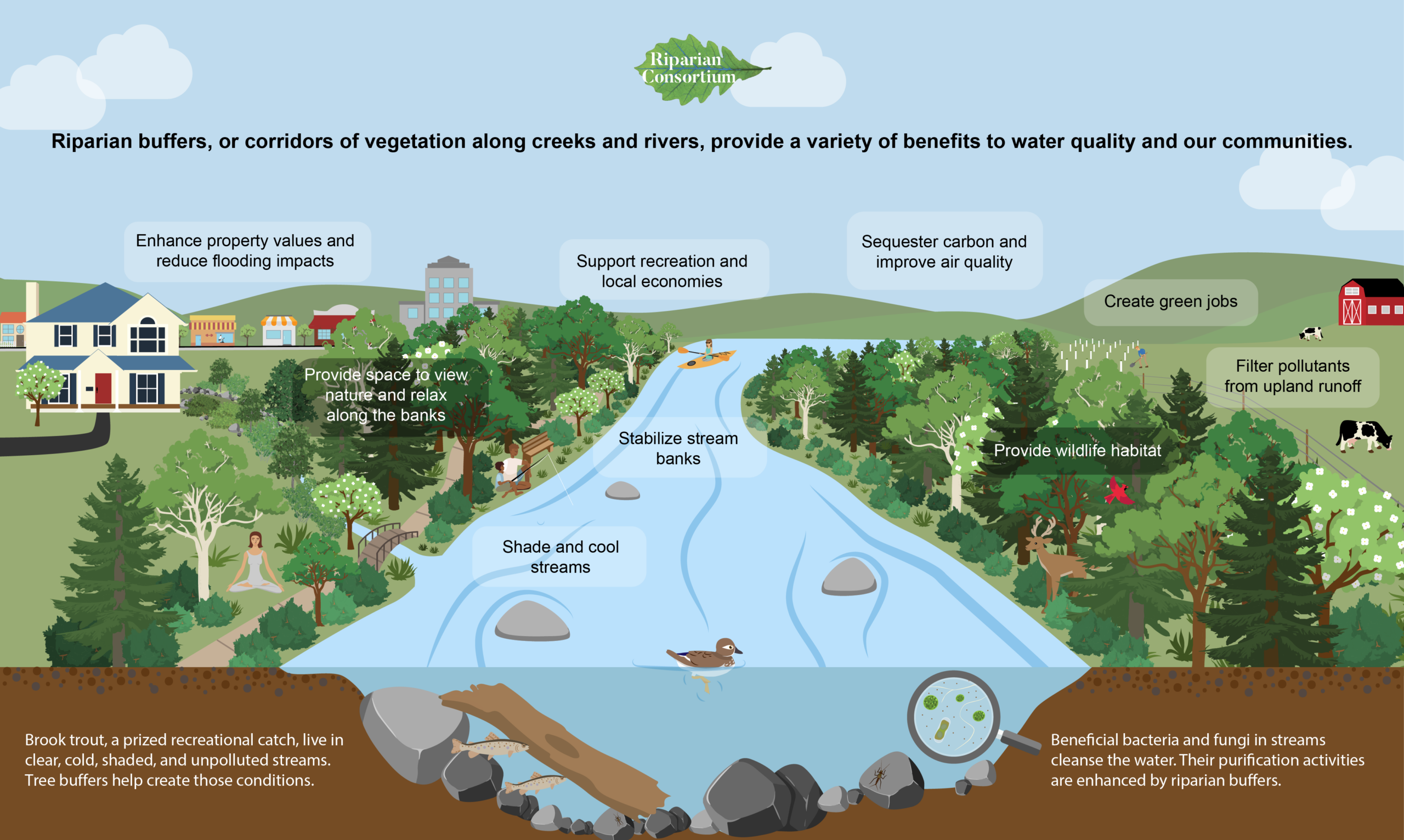
Why do buffers matter?
They offer COMMUNITY BENEFITS:
Enhance property values and reduce flooding impacts
Residential properties which border forested areas, or have established forest cover, can fetch between 18-35% more value than those without. Additionally, riparian buffers can sow down water and reduce impacts from high water events. (Green Cities: Good Health)
Provide space to view nature and relax along the banks
Riparian forests contain key elements for our sense of well-being, including water, trees, and birdsong. After just five minutes in a forest surrounded by trees, the heart rate slows, facial muscles relax, and the prefrontal cortex quiets. Water and birdsong have also been shown to improve mood and alertness. (Mindful, The Nature Fix)
Create green jobs
The green workforce in the US employs nearly 9.5 million workers. There are a variety of riparian forest buffer jobs from indoor to hybrid to outdoor positions. (Careers in Conservation, US Green Economy)
Support recreation and local economies
By adding riparian buffers, property owners can enjoy shaded streamside paddling trips and walking trails. Buffers also act as a wildlife corridor, which adds opportunities for birding, fishing, and hunting. (Virginia Scenic Rivers Program)
They offer WATER & AIR QUALITY BENEFITS:
Sequester carbon and improve air quality
Planting riparian forests helps to jump start carbon sequestration. In urban areas, forest buffers can help reduce temperatures and offset air pollution. (How Trees Clean Air)
Shade and cool streams
Colder water carries more dissolved oxygen than warmer water. This is imperative for species such as trout, which require cool, oxygen rich waters to survive. Riparian buffers provide shade over waterways to help keep our streams cool. (Cold, Clear and Clean)
Stabilize streambanks
Roots from streamside trees and shrubs act like a net to hold soil in place, helping to prevent erosion. During flooding events, riparian forests help to deflect and slow rising waters. (The Magic of Live Staking)
Filter pollutants from upland runoff
Riparian buffers act like sponges, collecting runoff during precipitation events. These nutrients are then stored in the floodplain soils instead of contaminating our waterways. This helps reduce pollution and algae blooms. (Stoney Crest Farm)
They offer WILDLIFE BENEFITS:
Beneficial bacteria and fungi in forested streams cleanse the water
Forested streams remove 2-9x more nitrogen pollution, have 2-5x more biological activity, have 2-4x more stream bottom area, and provide better conditions for biofilm, which regulates the processing and export of nutrients and organic matter. (Stream and Buffer Ecology, Stream Biofilms)
Brook trout, a prized recreational catch, live in clear, cold, shaded, and unpolluted streams
Not only do riparian buffers shade our waterways, but having a diverse species selection helps to bolster macroinvertebrate populations which benefits trout numbers. (Fish Need Leaves)
Provide wildlife habitat
Oak species are considered a keystone species and provide food to over 557 types of moths and butterflies. This in turn provides food for untold numbers of bird species in riparian buffers. Oaks are just one of 5 keystone species found in typical riparian forest buffer plantings. (Riparian Plant Guide)
Thanks to the James River Buffer Program for this information.